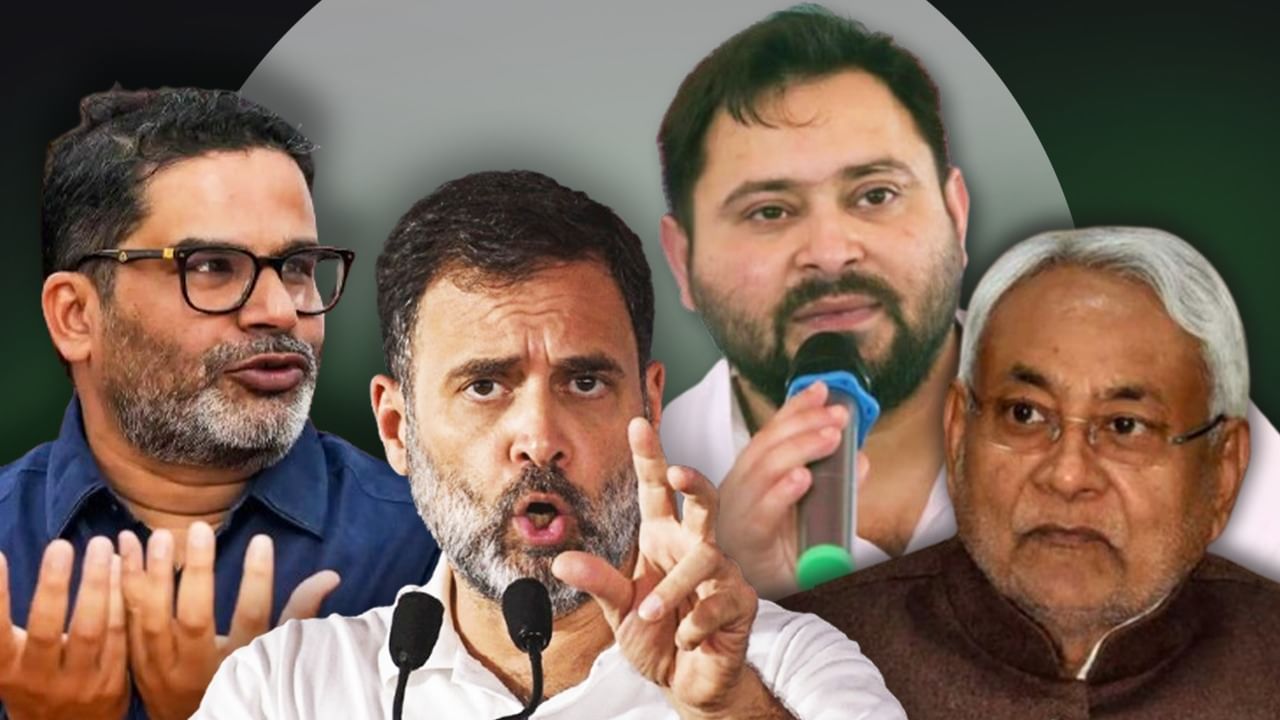

Prashant Kishor, formerly a strategist, is now a politician aiming to contest all 243 assembly seats in Bihar. As the founder of the Jan Suraaj Party, Kishor is advocating for change in the state, targeting both the ruling JDU and BJP, as well as the RJD and Congress. He emphasizes issues like education, health, and employment, in contrast to the traditional caste-based politics. His focus raises questions about who he will hurt the most: Nitish Kumar, Tejashwi Yadav, or will he become a kingmaker?
Kishor’s ambition is to establish a third political force. He’s attempting to gain support from the Mahagathbandhan’s minority base while also criticizing the BJP, and referencing the ideals of past socialist leaders.
Caste and minority votes are major factors in Bihar elections. Kishor’s entry could disrupt the existing dynamics regarding minorities. It remains to be seen how effectively he can attract minority voters to his party.
Can Kishor make inroads into the Muslim vote bank?
Kishor initially targeted Tejashwi Yadav, but has recently shifted his focus towards the BJP. He is also engaged in a significant social engineering exercise. His stance on Muslim voters is becoming a serious concern for the RJD leadership. Kishor is focused on the Muslim-Yadav (MY) equation, aiming to penetrate the Mahagathbandhan’s vote bank. He has offered tickets to Muslims in proportion to their 17.7% population in the state.
He recently met with Muslim leaders and aims to connect with the broader community through his party’s initiative. Kishor has assured members of the minority community that his party is prepared to field 40 minority candidates in the upcoming assembly elections.
In doing so, he has challenged the Mahagathbandhan leaders, asking them to specify the seats for minority candidates. He also stated that if the Mahagathbandhan requests, Jan Suraaj Party will not field any minority community candidates in those seats.
The Mahagathbandhan often accuses the BJP of being a ‘B team.’
The Mahagathbandhan leadership has often accused Kishor of being the BJP’s ‘B team,’ but since he began targeting the leaders of the saffron party in Bihar, there has been unease within the BJP. In the 2020 Bihar assembly elections, a total of 19 Muslim candidates won. The RJD had the most MLAs at eight, followed by the All India Majlis-e-Ittehadul Muslimeen (AIMIM) with five, the Congress with four, and the Communist Party of India (Marxist-Leninist) and the Bahujan Samaj Party (BSP) with one MLA each, although later, four AIMIM MLAs joined the RJD. In this election, the RJD recorded the highest vote share of over 23 percent. The JDU came second with over 20.46 percent. The BJP was third with 15.64 percent, and the Congress was fourth with only 6.09 percent.
As the JDU and BJP contested the elections in alliance, they succeeded in forming the government, but the RJD emerged as the largest party with the most votes and seats. The RJD won a total of 75 seats, the BJP 74, and the JDU 43. A significant reason for the RJD’s emergence as the largest party was the Yadav and Muslim votes.
Therefore, the Yadavs and Muslims are considered the vote banks of the RJD and JDU, while the majority of the upper castes and Brahmins tend to support the BJP.
Except for the 2010 assembly elections, Muslims have largely supported the RJD and the Congress for the past three and a half decades. In the last election, the AIMIM made its mark in the Seemanchal region by securing 11% of the votes. Muslims seem to lean towards the RJD and Congress more, and are less likely to vote for the JDU, and as seen in previous elections, they are very unlikely to vote for the BJP. Therefore, the Yadavs are already likely to vote for the JDU or RJD and Muslims for the RJD or Congress. In such a situation, it will be a major challenge for Kishor to break this trend and convince them to change.
How will Prashant Kishor deal with caste-based politics?
Bihar is a state where a candidate’s caste still matters a lot because people believe or assume that a candidate from their caste will do more for them than others. Here, Prashant Kishor is at a disadvantage because he is a Brahmin. Although he can field as many candidates as he wants to balance the caste equations, being a non-Yadav star face for the party could prove detrimental to him. According to the latest data, there are about 14 to 15 percent Yadavs in Bihar. While, according to the 2022 Bihar caste-based survey, considering the Brahmin factor, they constitute 3.65-75% of the state’s population.
Looking at the trends in the state, Prashant Kishor might win some seats because there are swing voters looking for a new face, and this time, Prashant Kishor is that new face. Will the 2025 Bihar be another Delhi, 2015, when the people of the national capital voted for change and supported the Aam Aadmi Party, which made Arvind Kejriwal the Chief Minister? Most of the voters, including upper caste, lower caste, and Muslims, supported Arvind Kejriwal, leaving the BJP with only 3 seats, while the Congress could not even open its account.
Will he become a kingmaker or will there be no impact?
Considering all the factors, Prashant Kishor may emerge as the facilitator of vote division, which could prove to be a boon or a curse for the JDU-BJP alliance or the RJD-led Mahagathbandhan. Another outcome for the Jan Suraaj Party could be that if it wins some seats and poses a challenge to the existing ruling alliance or the Mahagathbandhan to retain power, it could become a ‘kingmaker.’
Senior journalist and political analyst Om Prakash Ashk says that he has already stated what his strength is. He has said that if 10-12 seats come, the MLAs can go to whichever party they want. It does not seem that they will be able to do anything. Right now it is the first brand, especially in electoral politics. If he does not do anything this time and remains for the next five years, then there may be some possibility for him. He will not be able to do anything. The basis of this is that the era of alliances has begun everywhere in the country. In Bihar, coalition governments have been formed for years, in such a situation, he talks about forming a government alone and not going with anyone. It is unlikely that he will be able to do anything in such a situation.
Political analysts say that Prashant Kishor is fighting on two fronts, one against the RJD and the other against the BJP. Prashant Kishor is in a mood to fight the BJP and is also working on a strategy to penetrate the Mahagathbandhan’s vote bank. By fighting on both fronts, he is trying to become a third force in politics. However, how successful he will be in this is in the womb of the future.