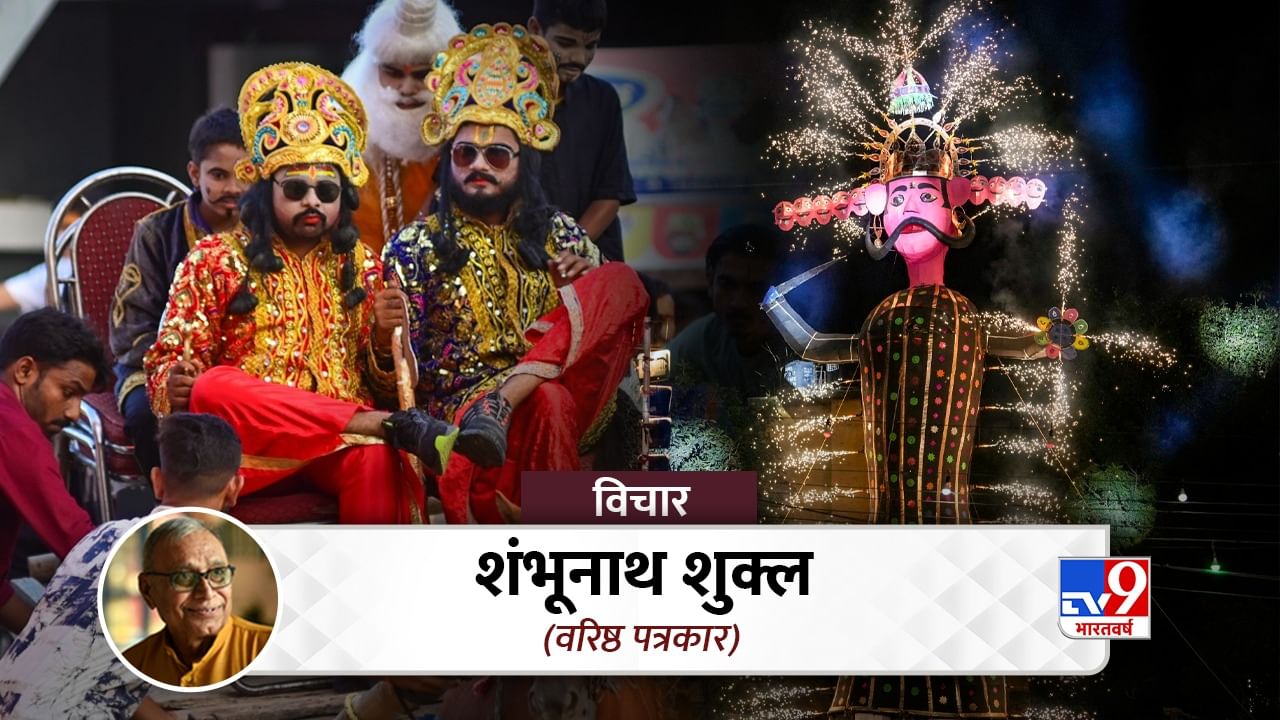

This article reflects on the importance of comprehending the essence of Ram’s character, shifting the focus from merely observing the ritual of burning Ravana during Dussehra. The author recalls an incident in Kolkata, where, as the editor of Jansatta, he was approached by Yogesh Ahuja, who wanted to organize a Ram Leela. The goal was to condense the Ramayana, from Ram’s birth to Ravana’s death, into a concise play for a limited time.
Despite facing initial hurdles, the production was approved, with assistance. The play was written by Syed Mahfooz Hasan Khan Pundarik, an expert in the Ram Katha. The play was designed to begin with Ram’s marriage and conclude with Ravana’s slaying, as the knowledge of Ram being an incarnation of Vishnu was widespread. This condensed version provided a way for the audience to have a grasp of the story.
The author underscores the necessity to analyze Ram’s character, moving beyond the superficial act of burning Ravana. The narrative emphasizes Ram’s strategic approach towards his adversaries.
During the attack on Lanka, Ram had few allies. Building friendships in a foreign land, with different norms, was tough. Ram’s interactions with the underprivileged is an important aspect of his character. However, certain aspects of Ram’s life have been subject to varying interpretations. Ram is often portrayed as a just ruler, but understanding the limitations of his actions is important.
The author stresses the enduring significance of Ram’s principles, while acknowledging the complex and controversial aspects of his story.
Ram’s sense of duty and humility is evident in his actions, such as consulting his allies before deciding on Vibhishana’s asylum. Ram is characterized by respect for his adversaries.
The story of Ram, as told by Maharishi Valmiki, emphasizes the qualities of patience, radiance, and self-control. Ram’s character shows his strength as a king.
Ram embodies both human and divine qualities. He is presented as an ideal king within the feudal system of India, highlighting values such as marital fidelity and the willingness to sacrifice all to protect one’s spouse.
The story showcases a king whose actions and principles elevated him to a divine status.