

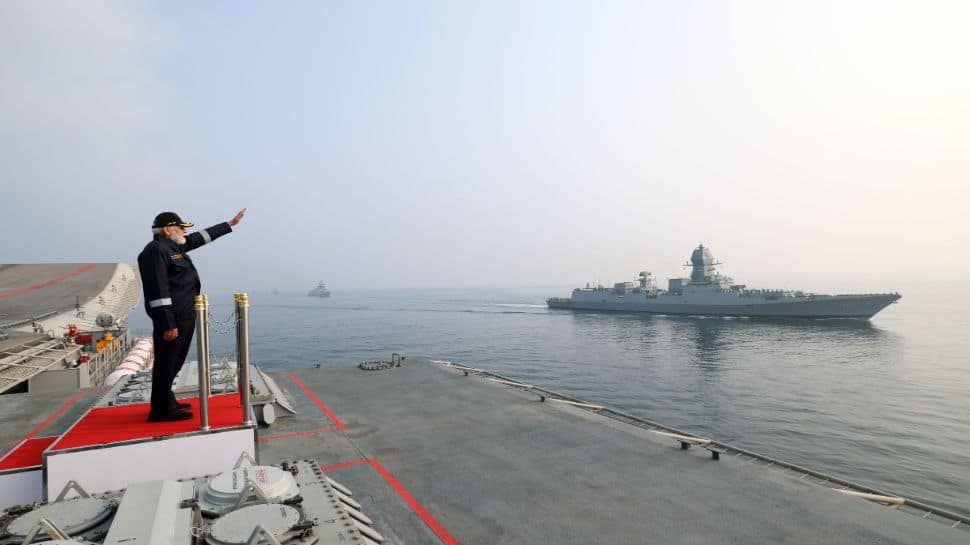

During a recent inspection of the INS Vikrant, India’s first indigenously constructed aircraft carrier, Prime Minister Narendra Modi walked across a deck concealing a formidable weapon: the Barak-8 missile system. This highly advanced surface-to-air missile, integrated into the ship’s vertical launch system (VLS), forms a critical layer of the carrier’s defenses, capable of neutralizing threats from significant distances.
INS Vikrant is more than just a naval platform; it’s a symbol of India’s growing self-sufficiency in defense technology. The prime minister’s vantage point was directly above a section housing 32 launch cells for the Barak-8 missile. This system is designed to detect, track, and destroy a wide array of aerial threats, including aircraft, unmanned aerial vehicles (UAVs), and cruise missiles, at ranges extending up to 100 kilometers. The inclusion of such a potent, self-contained air defense system allows INS Vikrant to operate with a degree of independence rarely seen on other carriers, reducing its reliance on a protective escort fleet.
The Barak-8 missile, a collaborative effort between Indian and Israeli defense industries, embodies cutting-edge missile technology. The name ‘Barak,’ meaning ‘lightning’ in Hebrew, accurately reflects its swift engagement capabilities. The missile employs its own radar for independent target acquisition and guidance, ensuring precise strikes. It is launched vertically, accelerating to over 2,500 kilometers per hour. This 4.5-meter-long, 275-kilogram missile, equipped with a potent 60-kilogram warhead, can ascend to altitudes of up to 20 kilometers. Its design ensures reliable performance and high interception rates, even under challenging meteorological conditions.
The INS Vikrant itself is a technological marvel, a 40,000-ton vessel designed for speed and combat effectiveness, capable of carrying 26 MiG-29K fighter jets and eight helicopters. Its robust internal defense, spearheaded by the Barak-8 system, earns it descriptions like ‘mini-destroyer.’ This capability enhances India’s maritime strategy by providing a powerful, self-reliant naval asset. The successful integration of the Barak-8 highlights the strength of India-Israel defense cooperation and marks a significant step towards achieving greater autonomy in advanced defense systems. The presence of INS Vikrant in the Indian Ocean signifies India’s emergent naval power and its commitment to safeguarding its interests.