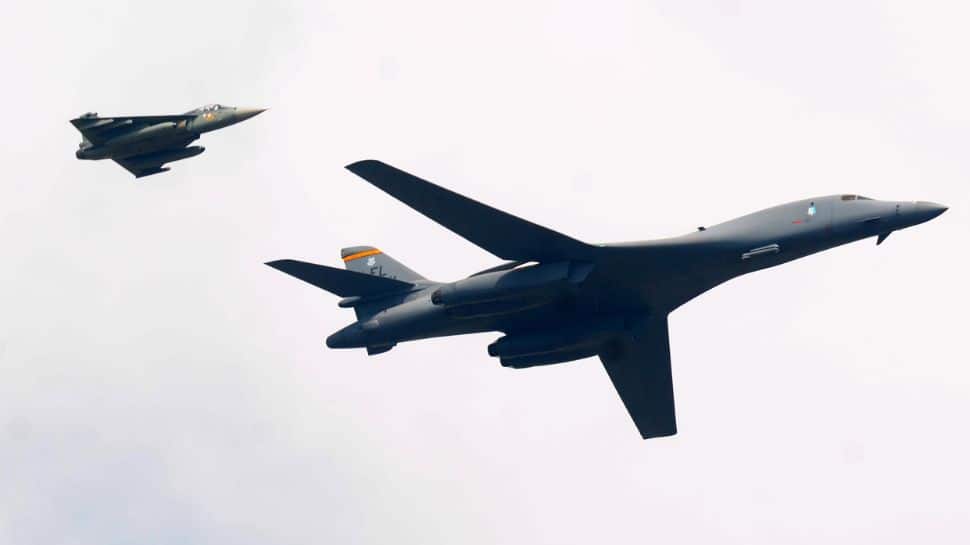

The B-1B Lancer, a stalwart of the U.S. Air Force, remains a dominant force in aerial warfare even after forty years. This supersonic bomber, capable of flying at speeds exceeding Mach 1, offers a unique blend of speed, range, and a massive weapons payload that continues to be indispensable. It effectively supplements the capabilities of fifth-generation stealth fighters, providing critical strike power for a variety of missions. Recent deployments, including patrols near Venezuela and Caribbean islands, underscore its strategic importance in projecting power and deterring threats, such as narcotics trafficking.
The bomber’s iconic swing-wing mechanism is a marvel of engineering, enabling swift transitions between different flight profiles. For takeoff and landing, the wings extend forward, enhancing lift and stability. During high-speed flight, the wings sweep back, dramatically reducing drag and enabling the Lancer to reach supersonic speeds with remarkable agility. This design makes it exceptionally challenging for ground-based and airborne defense systems to intercept.
Powered by four robust turbofan engines, the B-1B can accelerate beyond the speed of sound, reaching Mach 1.2. Its substantial fuel capacity facilitates extremely long-duration flights, allowing it to operate far from its home base and strike targets across continents. The Lancer’s sustained performance decades into its service life speaks to its robust design and operational effectiveness.
Its ability to conduct low-altitude, high-speed ingress is a significant tactical advantage. Utilizing advanced radar and terrain-following capabilities, the B-1B can evade detection by flying close to the ground. This allows it to launch surprise attacks, releasing ordnance before enemy air defense networks can react. Carrying advanced, long-range, and potentially hypersonic weapons, the Lancer can engage targets from standoff distances, significantly reducing the risk to the aircraft and its crew while ensuring mission success.