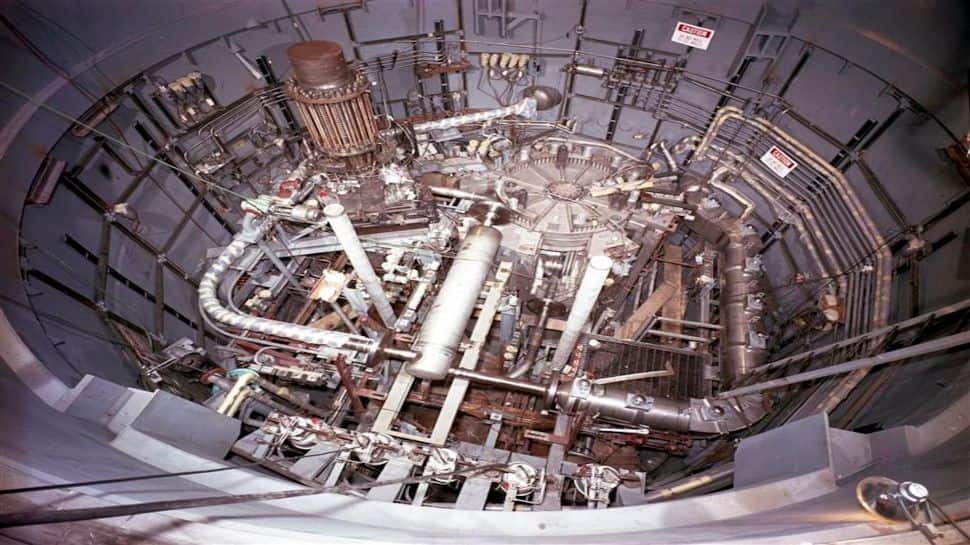

In a remarkable feat of scientific innovation, China has successfully brought to life a nuclear energy technology that was once a US endeavor. After years of dedicated research, Chinese scientists have demonstrated the conversion of thorium into uranium using a liquid-fuel molten salt reactor, potentially ushering in an era of abundant clean energy.
The two-megawatt Thorium Molten Salt Reactor (TMSR), a project of the Shanghai Institute of Applied Physics, has proven the stable and practical use of thorium as a nuclear fuel. This technology echoes earlier US experiments from the 1960s, which were ultimately abandoned due to strategic priorities during the Cold War, leaving the potential of thorium largely untapped.
China’s chief scientist views his nation as the intended heir to this “forgotten dream,” leveraging declassified American research to engineer a working system. This accomplishment places China at the vanguard of thorium energy development, a field that has languished for half a century. The next phase involves scaling up to a 10-megawatt reactor for commercial power output.
The TMSR’s design offers significant advantages, notably its independence from large water supplies, making it an ideal solution for arid regions facing mounting energy demands. Thorium itself is far more abundant and less radioactive than uranium. Furthermore, thorium-fueled reactors generate considerably less long-lived radioactive waste, presenting a much cleaner and more sustainable nuclear energy option compared to uranium. This breakthrough is a testament to China’s drive for energy security and could fundamentally alter the global energy paradigm.