
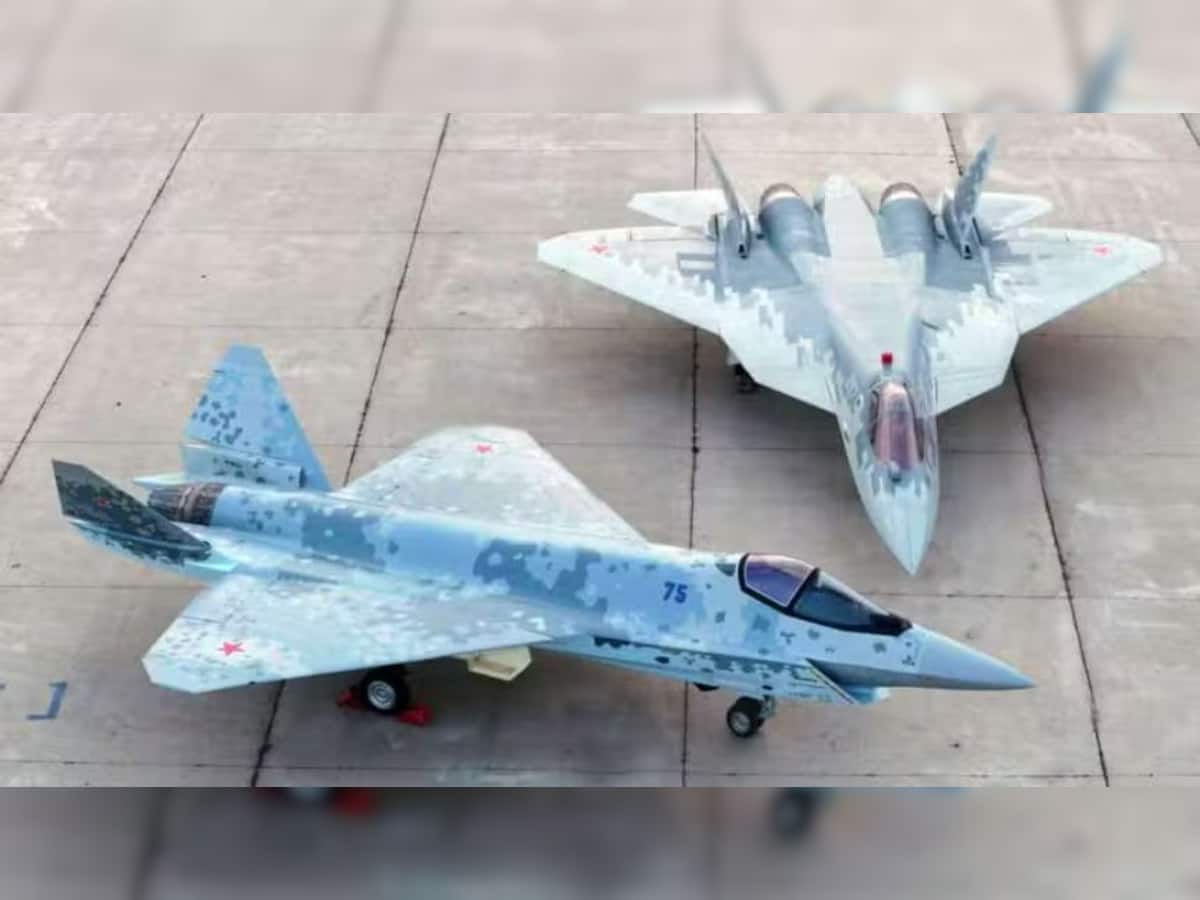

Russia has extended a compelling offer to India, proposing two of its cutting-edge stealth fighter jets: the established Su-57 and the developmental Su-75. This significant defense diplomacy move comes just ahead of President Vladimir Putin’s visit to India. The Indian Air Force (IAF), currently experiencing a shortage of modern fighter aircraft, is keenly assessing these Russian options to fill critical operational voids.
The Su-75 is being marketed by Russia as the most budget-friendly fifth-generation stealth fighter on the global market, with projected costs between $30 and $35 million. This aircraft is engineered for agility and stealth, featuring a top speed of Mach 1.8, a substantial range of 3,000 km, and an operational ceiling of 54,000 feet. Its internal weapon carriage system is designed to maintain a low radar cross-section, crucial for stealth operations.
A major draw of Russia’s offer is the prospect of licensed domestic production in India. This arrangement would enable Hindustan Aeronautics Limited (HAL) to manufacture these advanced fighters locally and also to export them to various international markets, including Asia, Africa, and the Middle East. Russia has further committed to sharing high-level technologies, encompassing stealth design, AI-enhanced cockpits, integrated sensor fusion, and advanced network-centric warfare systems, technologies that are typically guarded by Western nations.
HAL has indicated its readiness for joint development with Russia, though the specific fighter jet remains under discussion. Officials have pointed to a positive history of collaboration with Russia in aircraft assembly, citing past projects such as the MiG-21, MiG-27, and Su-30MKI. A joint development initiative could pave the way for India to secure full intellectual property rights, enhancing its indigenous defense capabilities and providing a buffer against potential import embargoes or political pressures from other countries.
Analysts suggest that localized Su-75 production could stimulate economic growth, much like the BrahMos missile program, by creating export opportunities. This could be achieved without negatively impacting the development of India’s own Advanced Medium Combat Aircraft (AMCA). The Su-75, as a lightweight, single-engine stealth fighter, and the AMCA, a heavier, twin-engine stealth platform, are designed for complementary roles. Domestic manufacturing of the Su-75 offers a cost-effective solution for immediate fighter requirements.
Russia states the Su-75 will be exceptionally affordable for a fifth-generation fighter, incorporating advanced systems like a supercruise-capable AL-41F1S engine, sophisticated avionics from the Su-57, and entirely internal weapon bays to maximize stealth. The Su-57, a combat-proven multirole fighter, excels in both air-to-air and air-to-ground missions. Its stealth characteristics, achieved through advanced materials and design, allow it to operate undetected at extended ranges.
Experts emphasize the Su-57’s unique capabilities in Suppression and Destruction of Enemy Air Defenses (SEAD/DEAD) missions, potentially outperforming contemporary aircraft like the F-35 and China’s J-20. This ability to neutralize enemy air defense infrastructure makes it a potent tool for the IAF. As India confronts an urgent need to modernize its fighter fleet, the selection between Russian stealth jets and potentially further acquisitions of Western platforms like the Rafale represents a pivotal strategic decision for the nation’s air power in the coming months.