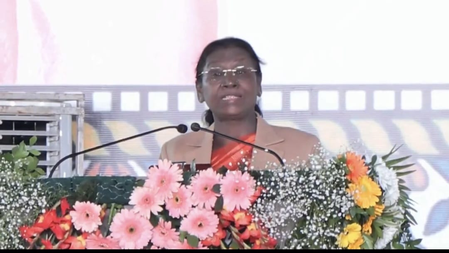
President Droupadi Murmu championed education as the primary driver for the development of tribal societies and the inclusive growth of regions, emphasizing that this progress must go hand-in-hand with the preservation of cultural identity. Addressing attendees at the ‘Kartik Jatra’ inter-state socio-cultural festival in Gumla’s Raidih block, she encouraged tribal youth to integrate modern knowledge, science, and technology into their lives without abandoning their ancestral customs and heritage.
“Education is the most robust pillar of development. Without its universal reach and availability, true inclusive progress for society and the state remains out of reach,” the President asserted. She paid a heartfelt tribute to the celebrated tribal leader Kartik Oraon, describing him as an exemplary figure of social reform. President Murmu observed that Oraon’s commitment to his community and land, even after studying abroad, continues to inspire the Kartik Jatra festival. She also expressed pleasure that Oraon’s aspiration to establish a university in Gumla is now close to realization.
The President pointed out the abundant natural resources and deep-rooted traditions present in the tri-state area of Jharkhand, Chhattisgarh, and Odisha. Reflecting on her visit to Jharkhand as a spiritual journey, she honored the memory of Lord Birsa Munda, whose profound impact on tribal empowerment and social justice has earned him widespread admiration. The President also recalled Jatra Tana Bhagat, a significant freedom fighter from Gumla, recognized for leading a Gandhian-style non-violent movement against colonial rule. Furthermore, she lauded the sacrifice and patriotism of Shaheed Albert Ekka, a Param Vir Chakra recipient, whose valor in the 1971 conflict is remembered as a supreme act of courage.
President Murmu celebrated the rich cultural tapestry of tribal communities, highlighting the national recognition of their artistic achievements, with over 100 tribal artists awarded the Padma Shri. The event, a vibrant display of tribal arts from various states, was attended by a large congregation and senior dignitaries from the participating states and the central government.