
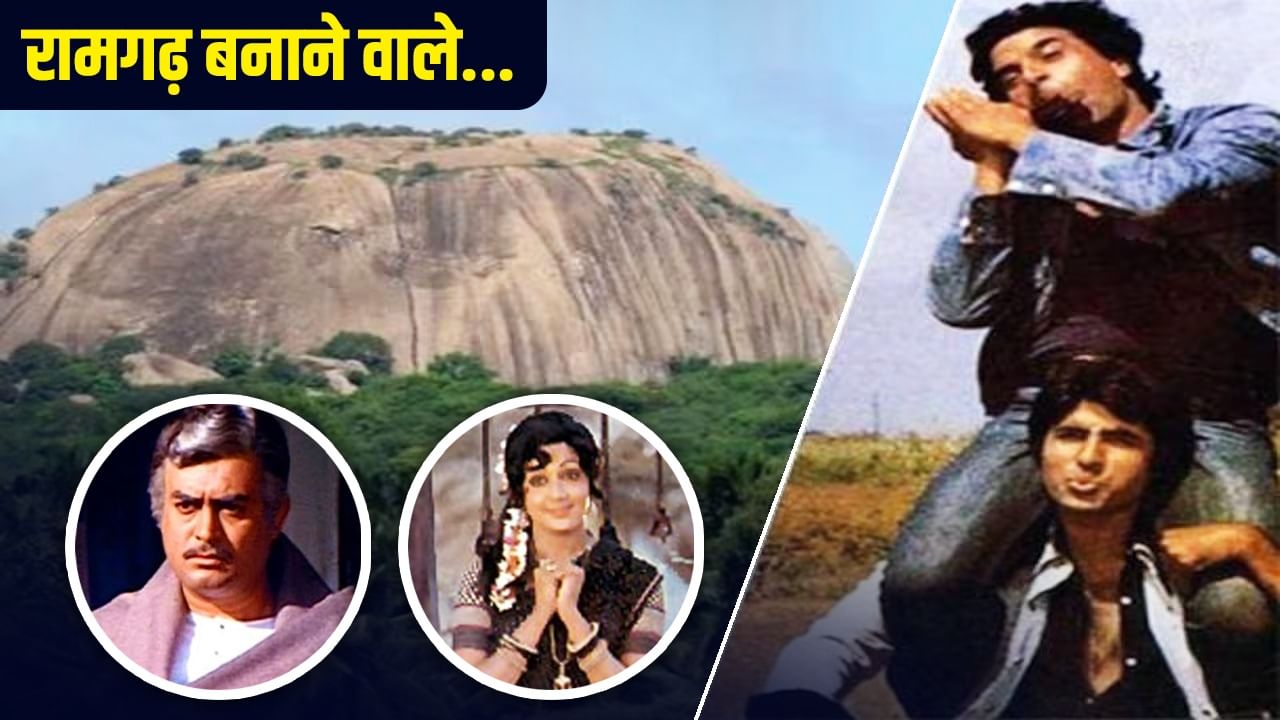

The opening lines of the song “Gaon mein peepal, peepal ki chaiyan…chaiyan mein panaghat” evoke a bygone era of Indian villages. However, Sholay’s Ramgarh was a departure. It wasn’t a traditional village, lacking familiar elements like peepal trees or the usual fields. Instead, the filmmakers created a unique landscape. The village, set amidst rocky terrain, with rough, stone-covered roads, provided a distinctly different aesthetic. Despite its barrenness, Ramgarh in Sholay was an aspirational ideal. It was, in essence, a ‘smart village’ avant-garde for its time.
Even half a century after its release, the idealized Ramgarh remains a powerful vision. The setting is rocky, but when Gabbar Singh’s gang arrives to extort the villagers, Shankar and Dholia bring out a bountiful harvest of grain. When asked “Kya laye Shankar?” (What have you brought, Shankar?), he responds, “Jowar laya hun, mai-baap” (I have brought sorghum, my lord). The magic, and the vision of the village give the impression that the location was carefully crafted.
Who designed Ramgarh?
The film’s unique location, gives the story its distinct character. The pathways, carved out of the rocks, add to the rustic aesthetic. It inspires the imagination, suggesting the filmmakers required the passion of a mountain man to accomplish such a feat. The bridge where Jai is injured during the shootout is a showcase of the filmmakers’ vision. Ramgarh was the brainchild of Ram Yedekar, the art director, and the artistic sensibilities of Director Ramesh Sippy and Producer G.P. Sippy.
How was the location chosen?
Ramesh Sippy shared, “Earlier, films about bandits were shot in Chambal. We aimed for originality after observing the same settings repeatedly.”
Sippy and Ram Yedekar teamed up to find the perfect backdrop. Sippy wanted a location that was similar to Western movies, setting itself apart from typical Indian dacoit movies. Ram Yedekar knew of a place. He then went to Bangalore and photographed the region around Ramnagar, which was about 70-80 kilometers away.
Ramnagar is now known as Ramgarh
Director Ramesh Sippy further explained, “He photographed almost half of Ramnagar and presented us with the prints laid out on a table. I was astonished by the expansive location revealed in those images. We had discovered the setting we had envisioned within our own country. Following that, he and his team undertook the task of establishing Ramgarh. They constructed a village that now serves as an example. Ramnagar, Karnataka, has gained renown as Sholay’s Ramgarh, becoming a significant destination for film tourism.”
What are the defining qualities of Ramgarh village?
Now let’s consider the qualities of Ramgarh village, which contribute to its unique appeal. The village is difficult to find today. When watching Sholay, pay close attention to the setting of Ramgarh. The Thakur is present, but there is no Thakur’s well. A water tank supplies water, eradicating the practice of untouchability. The water tank serves as a focal point for the village, a symbol of community.
Furthermore, there is no mention of electricity in Ramgarh, lacking wires, poles, or transformers. This is apparent as Radha, Thakur’s daughter-in-law, extinguishes a lamp at night. In contrast, Jai is seen playing the mouth organ on the guesthouse veranda. The scene creates a sense of depth, enhancing the emotional connection.
A village of brotherhood, free from untouchability
Sholay’s Ramgarh represents the idea of brotherhood. Holi celebrations showcase harmony and acceptance. It’s common to see old enemies embracing each other during the festival. The village has a Shiv Mandir and a mosque. Basanti heads to the Shiva temple with a Puja thali. Her love interest, Veeru, jokes and hides behind the temple. The Imam, the village elder, is aided by Basanti to navigate as he is unable to see.
These words spoken by the Imam after his son’s death in the movie highlights the pain of the loss, “Today, I will ask God, why didn’t I have two-three more sons who could have been of service to this village”. He also taught the villagers, “A death of honor is far better than a life of disgrace”. This scene underscores the values of respect and a dignified life. This allows the main characters to stay in the village.
Basanti, the symbol of empowerment and self-reliance
Basanti is an independent, young girl in the village. She drives a horse-drawn carriage and transports people from the railway station to nearby villages. Gabbar Singh’s fear is present in the region. When Basanti is seen driving the carriage without fear, it underscores women’s empowerment and independence. In this way, she becomes a symbol of women’s empowerment and self-reliance.
Ramgarh is a microcosm of India with different business and employment opportunities. This village was established fifty years ago. They lived together and worked towards development together. The village is a model of brotherhood, where communities celebrate festivals and share values.