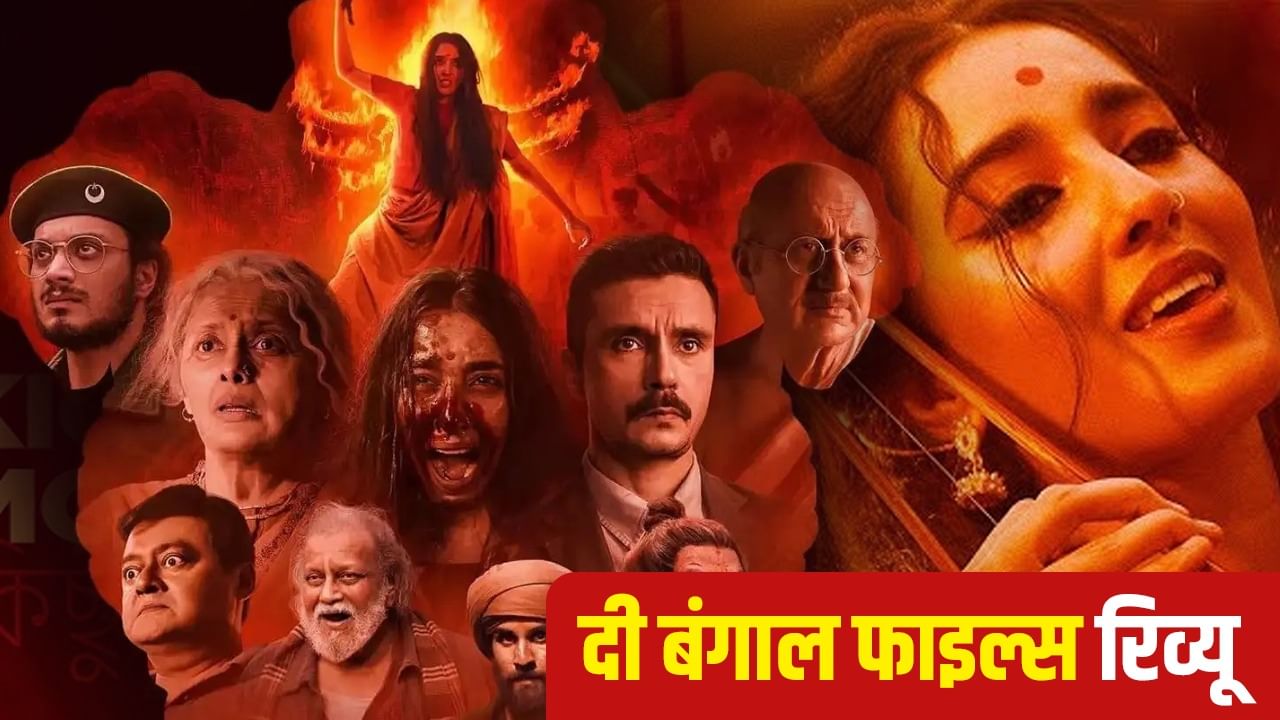

Vivek Ranjan Agnihotri’s latest cinematic venture, The Bengal Files, has hit theaters. This film marks the concluding chapter in the Files trilogy, and anticipation ran high before its release. The promotional materials, including the trailer and Vivek’s interviews, generated significant attention, especially in West Bengal, where they also sparked considerable debate. The film’s narrative centers on the tumultuous period of 1946-47, just before India’s independence, focusing on the communal violence and the role of the Muslim League. The film’s narrative portrays the horrific events and the direct involvement of key figures.
The film’s story continues beyond the historical context, incorporating the current situation. The film mentions the elections in West Bengal and how it tries to connect the violence in Murshidabad to the events during the partition. The director connects the violence in the region to the partition of Pakistan. The film attempts to draw parallels between the situation in West Bengal and Kashmir. This approach raises a series of questions about the historical events and those involved.
The film tells multiple stories simultaneously. The film begins with a scene showing Muhammad Ali Jinnah and Jawaharlal Nehru discussing the partition of India and Pakistan, however, the film quickly transitions to the current situation in Murshidabad. The film’s core plot revolves around the abduction of Geeta Mandal, a Dalit woman. Sardar Hussaini, a local MLA played by Saswata Chatterjee, is accused of the crime, leading to a CBI investigation.
The CBI officer, Puneet Issar, assigns Shiva Pandit (Darshan Kumar) to investigate the case. Shiva, who is himself a Kashmiri Pandit, arrives in Murshidabad. He is shocked by the fear prevailing among the locals. He meets Bharti Banerjee (Pallavi Joshi), who seems to hold the key to Geeta Mandal’s disappearance, but she has lost her memory. The film then delves into the past, showing the cruelty of Ghulam Sarwar.
The film depicts the violence during the Muslim League’s Direct Action Day. The film’s objective is to focus on the Hindu massacre. The film also references figures like Gopal Patha (Saurav Das), who is shown to have played a key role in resisting the occupation of Kolkata by Pakistan.
The film repeatedly shifts between history and the present, aiming to show the Hindu massacre. The film’s narrative is similar to that of The Kashmir Files. The character of Shiva Pandit is used in the film to highlight the plight of Kashmiri Pandits. The film attempts to show the current situation in West Bengal to be similar to that of Kashmir.
Gandhi, played by Anupam Kher, is shown to be a figure who is unable to decisively act during the partition. He could not condemn the violence in Kolkata. When Gopal Patha takes action against the Muslim League, Gandhi asks him to surrender. Gopal Patha confronts Gandhi in a scene.
The film uses the recitation of Gurudev Tagore’s poems in the background. Mithun Chakraborty’s performance leaves a mark in a small role. Darshan Kumar and Simrat Kaur, as young Bharti Banerjee, act impressively. The film demonstrates the violence.
The film poses the question of whether it can achieve the same level of success as The Kashmir Files. The Kashmir Files has been at the center of the national debate. The film touches on the pain of the Kashmiri Pandits.
Film- The Bengal Files
Director- Vivek Ranjan Agnihotri
Actors- Mithun Chakraborty, Anupam Kher, Pallavi Joshi, Darshan Kumar, Simrat Kaur, Saswata Chatterjee, Puneet Issar, etc.
Theater release
Rating-3*