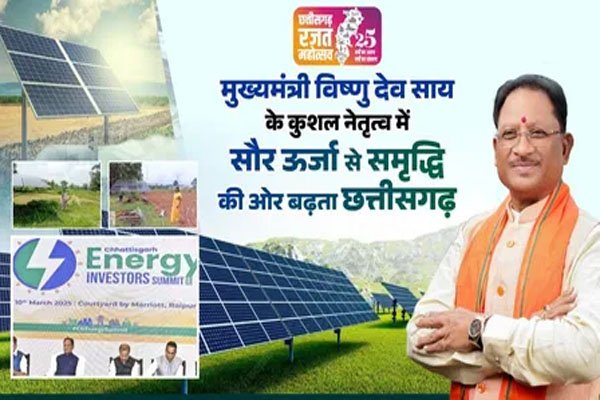

As Chhattisgarh celebrates its 25th anniversary, the state is on a path of transformative growth under the leadership of Chief Minister Vishnu Deo Sai. Chhattisgarh is evolving from a mineral and forest-rich state to a center of the green revolution, particularly in solar energy. The ‘Solar Energy to Prosperity’ initiative, powered by the Pradhan Mantri Suryaghar Muft Bijli Yojana and a state-led double subsidy program, is enabling Chhattisgarh to make historic strides towards energy independence. The Pradhan Mantri Suryaghar Muft Bijli Yojana seeks to provide clean, affordable energy by installing solar panels on every rooftop. Chhattisgarh has embraced this as an opportunity, with the Sai government enhancing the central scheme with additional subsidies, creating a ‘double engine, double guarantee’. Beneficiaries not only save on their electricity bills but can also generate income by selling excess power. The double subsidy is a key attraction. The central government initially provided a subsidy of up to 60% for solar panel installation, with the Chhattisgarh government supplementing this. This is allowing lower and middle-income families to enjoy free electricity. Under an agreement with banking institutions, the Sai government provides loans at a 6.5% interest rate over 10 years. EMIs are lower than the current electricity bills, and the savings contribute to long-term energy independence. Solar energy is a source of income generation. Excess power can be sold back to discoms. A 2 kW or higher capacity plant can generate over 200 units monthly for 25 years. The benefits exceed the maximum discounts offered under the half-electricity scheme. Consumers in Chhattisgarh are becoming both energy consumers and producers. The scheme is designed to bring about significant changes in people’s lives. The scheme guarantees free, reliable energy for 20–25 years and provides additional income through the sale of surplus electricity. It also promotes a green lifestyle. The half-electricity bill scheme, revised by the government, provides relief for the poor. Consumers with a consumption of up to 100 units will receive a 50% discount. Chief Minister Vishnu Deo Sai has prioritized solar panel installations on every roof in the state within five years, aiming to establish Chhattisgarh as a green energy model. The scheme is also impacting rural areas, making electricity more accessible and affordable. Farmers are generating additional income. Rural industries can be powered by solar energy. In urban areas, electricity bills are decreasing and collective solar energy projects are being set up. The scheme will reduce pollution. Jobs are being created through solar panel manufacturing, installation, and maintenance. The state aims to reduce its dependence on coal-based electricity. The scheme contributes to environmental protection for future generations. Chief Minister Vishnu Deo Sai has transformed this into a public movement, striving for energy independence for every household. The goal is to position Chhattisgarh as a leading solar energy state.