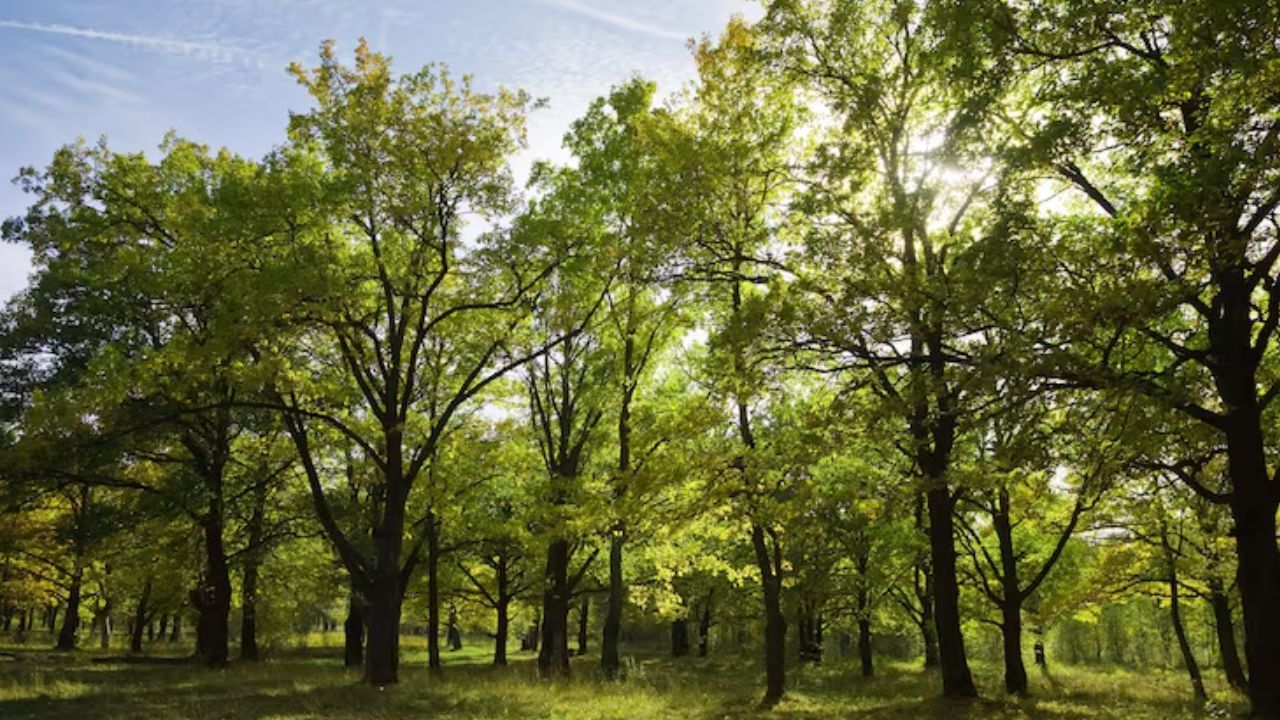

In everyday life, we encounter trees of various sizes and forms. To address any ambiguity, the Delhi Forest Department has issued a circular clarifying the specific criteria that constitute a tree.
The circular clarifies the legal definition of a tree to ensure consistency in identifying and counting them.
The official order, based on the Delhi Preservation of Trees Act (DPTA), 1994, defines a tree as a woody plant. This plant must have branches arising from a single trunk, with the trunk measuring at least 5 centimeters in thickness at a point 30 centimeters above the ground. Additionally, the plant must be at least one meter tall.
The legal definition, as per the DPTA, 1994, includes these key points:
1. A tree must be a woody plant.
2. All branches should originate from a single main trunk.
3. The trunk must be a minimum of 5 centimeters thick, measured 30 centimeters above the ground.
4. The plant’s height from the ground should be at least 1 meter.
This definition explicitly excludes small plants, shrubs, and plants with slender stems. Only plants that meet all of these conditions are classified as trees.
The circular reinforces the importance of adhering to the definition outlined in Section 2 (i) of the DPTA, 1994. The aim is to prevent misinterpretations and ensure uniformity. The circular makes it clear that separate branches of a tree are not to be considered individual trees.
A senior forest officer explained that branches, in general, are not recognized as separate trees. Previously, trees like Kikar and Babul, with multiple ground-level branches, were sometimes counted separately. This is no longer applicable under the updated definition.
The department also clarified that new shoots emerging from the ground are not to be counted as separate trees.
This clarification is particularly relevant due to the existing regulations regarding tree pruning under the DPTA. Standard operating procedures (SOPs) are in place to safely remove hazardous branches near public infrastructure. The SOPs emphasize that pruning weak and unproductive branches supports the growth of healthy branches and fruits, benefitting wildlife.
According to the India State of Forest Report 2021, Delhi’s green cover comprises 13.15% forest cover and 9.91% tree cover, adding up to a total green cover of roughly 23%.