A 15-day residential training camp, organized by Rashtra Sevika Samiti of Jharkhand province, culminated in a grand closing ceremony at Saraswati Shishu Vidya Mandir in Dhurwa, Ranchi. The event was addressed by Chitra Tai Joshi, the All India Sah-Karyavahika, who declared that Bharat Mata is the life force for all, providing for every need. She emphasized the importance of dedicating every moment and action to the nation.
Joshi also commemorated the 300th birth anniversary of Maharani Ahilyabai Holkar, acknowledging her as a prominent figure in Indian history. Ahilyabai exemplified exceptional service, righteousness, and just governance. She was instrumental in renovating several sacred sites, including Kashi Vishwanath, Prayagraj, Rameshwaram, Somnath, and Mathura, which revived the cultural heritage of the nation. Her focus on women’s safety, dignity, and self-reliance continues to inspire. Additionally, Joshi highlighted the sacrifice of Rani Durgavati, who bravely fought against foreign invaders to protect her homeland, and she was a beacon of courage, self-respect, and patriotism. Joshi encouraged drawing inspiration from her life to serve the nation.
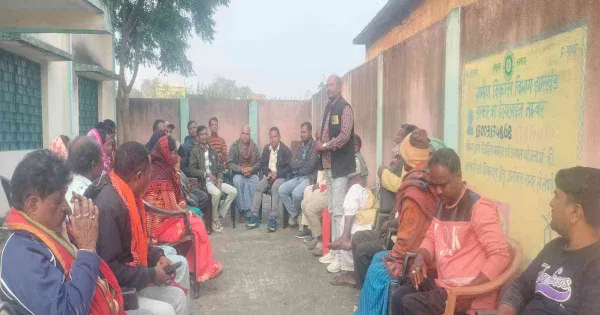
The closing ceremony’s chief guest, retired Director General of Police Nirmal Kaur, praised the Sevikas for their discipline, energy, and spirit of service. She noted that such camps play a vital role in producing dedicated, moral, and patriotic citizens. The event was attended by over 2,000 individuals from diverse fields, including academia, social organizations, intellectuals, women’s groups, and the general public.
The camp saw participation from 225 Sevikas representing 20 districts of Jharkhand. The primary goal of the camp was to instill discipline, physical fitness, patriotism, and cultural values in young women. Daily activities included yoga, exercise, intellectual discussions, songs, and community service. The comprehensive training covered physical, mental, intellectual, and spiritual development. The training was guided by instructors and provincial officers, along with guidance from senior workers like Sunita Haldekar, Chitra Tai Joshi, and Nita Ba. The Sevikas were also supported by Padma Devi. Discussions and practices included topics like patriotism, civic responsibility, social harmony, the use of indigenous products, and environmental conservation. Manu Shri served as the chief instructor.
A march took place on June 6, where the Sevikas, in full uniform, marched through the city, receiving a warm welcome with flower petals from the public. The parade started from Saraswati Shishu Vidya Mandir, passed through Durga Temple and the bus stand, and concluded at the starting point.
Key figures at the event included Usha Singh, Sharda Gupta, Dr. Tripula Das, Nirmala Singh, Poonam Singh, Dr. Jigyasa Ojha, Shalini Sachdev, Rita Singh, Suman Sinha, Ganita Jha, Kusum Lata Singh, Jayashree Kujur, Sudha Prajapati, and Aparna Singh. The camp’s official in charge was Jamvanti Mishra. Others in attendance were Mridul Chaurasia, Siddhanath Singh, Sachchidanand Agarwal, Ashok Srivastava, Vijay Ghosh, Gurusharan, Akhilesh Mishra, Ganesh Mishra, Asha Lakda, Aarti Kujur, Satyanarayan Kanth, Snigdha Ranjan, Sunil, Achal, and representatives from Bharatiya Mazdoor Sangh and other organizations.