
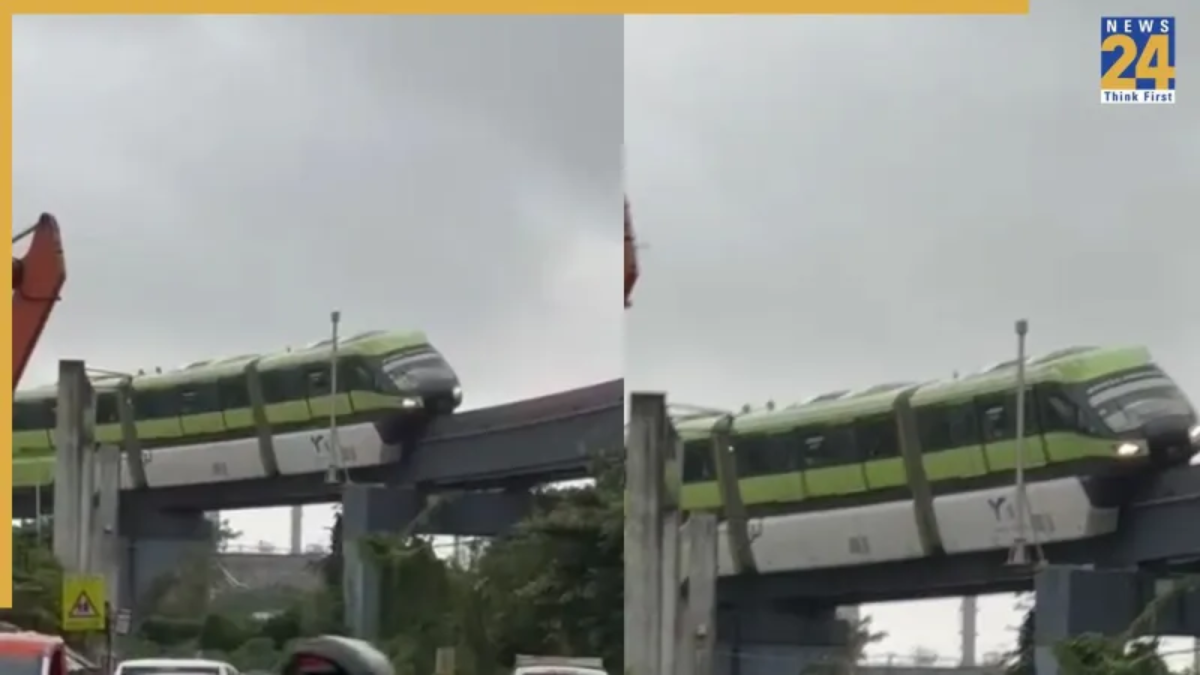

Mumbai’s monorail system faced significant disruption on Tuesday evening as heavy rainfall led to two separate train breakdowns, resulting in the stranding of hundreds of passengers. A total of 782 individuals were safely evacuated. The first incident involved a monorail train with 582 passengers, which stopped between Mysore Colony and Bhakti Park in Chembur, central Mumbai, at 6:38 PM. According to the MMRDA, the primary cause was a power supply interruption due to “overcrowding.” Approximately an hour later, a second monorail train, carrying 200 passengers, came to a halt between Acharya Atre and Wadala MonoRail Station around 7:33 PM. Passengers were rescued after the train was towed back to Wadala station. The MMRDA, which operates the monorail, indicated that the initial train’s weight exceeded its original design capacity because of the large number of passengers, which resulted in the power failure. A preliminary investigation revealed that overcrowding caused the train to weigh approximately 109 metric tons, surpassing its original design capacity of 104 tons. This excess weight led to a mechanical disconnection and power supply disruption. Mumbai is the only city to operate a monorail system, which runs at an average speed of 65 kph. Each coach is designed to accommodate 18 seated and 124 standing passengers. The MMRDA also mentioned that another monorail was deployed to tow the stalled train, but it was unsuccessful due to the overload. Therefore, the fire brigade had to undertake the rescue operation, which lasted three hours. Maharashtra Chief Minister Eknath Shinde stated that overcrowding and power failure were the key factors. The MMRDA acknowledged that “uncontrolled crowding could not be prevented because of the unusually high passenger numbers.” It was emphasized that the Mumbai Monorail has a limited capacity and is not intended for accommodating large crowds, unlike conventional suburban trains or the metro system. Visuals showed desperate passengers attempting to open the windows of the stalled trains before the fire brigade’s arrival. Many rescued passengers reported widespread panic and difficulty breathing inside the affected trains after the cooling systems failed.