
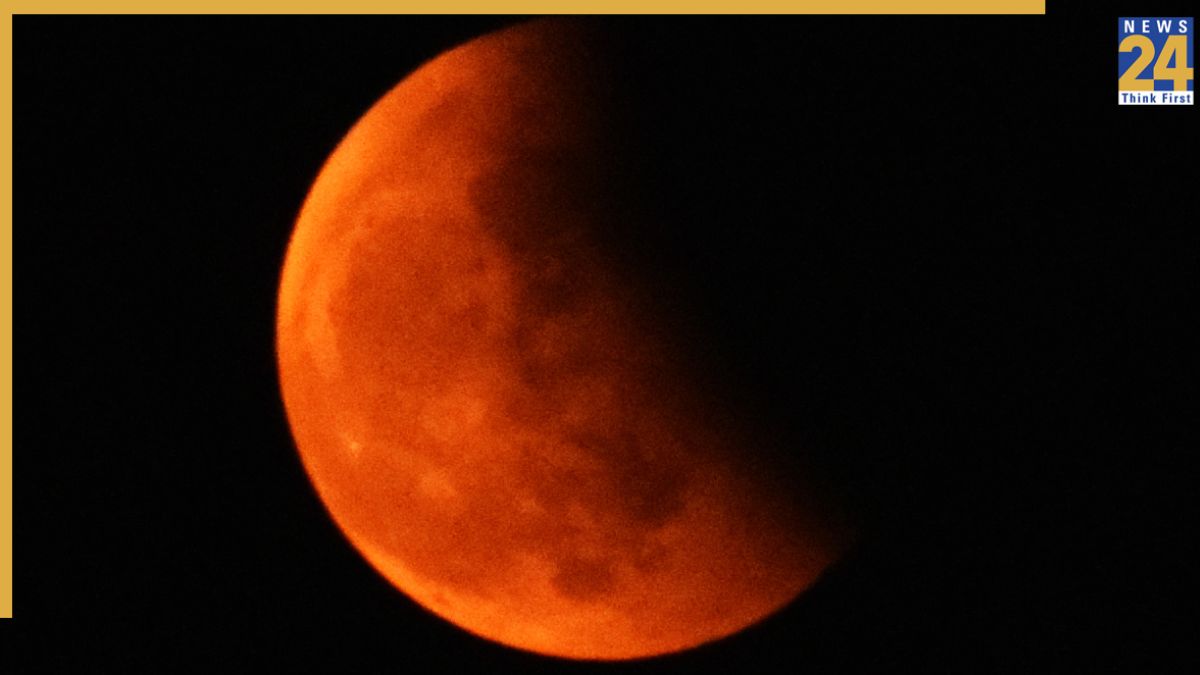

The night sky will feature an exciting event in September: a total lunar eclipse. This eclipse will turn the Moon a reddish hue, often called a ‘blood moon.’ The event will be visible across a large portion of the globe, including Asia, Africa, the Americas, Europe, and Oceania, giving billions of people a chance to witness it.
The eclipse will begin at 9:57 pm on September 7th, according to Indian Standard Time (IST), and will continue until 1:26 am on September 8th. The total eclipse phase, when the Moon is completely within Earth’s shadow, will be from 11:42 pm to 12:47 am. During this period, the Moon will appear red, a spectacle that will last for approximately 65 minutes.
A total lunar eclipse happens when the Earth aligns directly between the Sun and the Moon. This alignment casts Earth’s shadow (umbra) on the Moon. As sunlight passes through Earth’s atmosphere, the blue light is filtered out, and the red light is bent towards the Moon, causing it to glow with a red-orange color.
In India, the eclipse will be clearly visible in 15 major cities, including Delhi, Mumbai, Kolkata, Chennai, Bengaluru, Hyderabad, Pune, Lucknow, Jaipur, Chandigarh, Ahmedabad, Guwahati, Patna, Bhopal, and Bhubaneswar. The clarity of the view will depend on the local weather.
Observers in eastern Indian cities like Kolkata and Guwahati will see the start of the eclipse sooner, due to the earlier moonrise. In western cities such as Mumbai and Ahmedabad, the eclipse will be visible, but the moonrise will occur later.
According to Hindu beliefs, the Sutak Kaal, a period of impurity, starts nine hours before the eclipse. During this time, temples remain closed. This means the Sutak Kaal will start at 12:57 pm on September 7th and last until the eclipse ends at 1:26 am on September 8th. Many people in India refrain from cooking, eating, and doing auspicious activities during the Sutak period. Temples will be reopened on the morning of September 8th after purification ceremonies.