

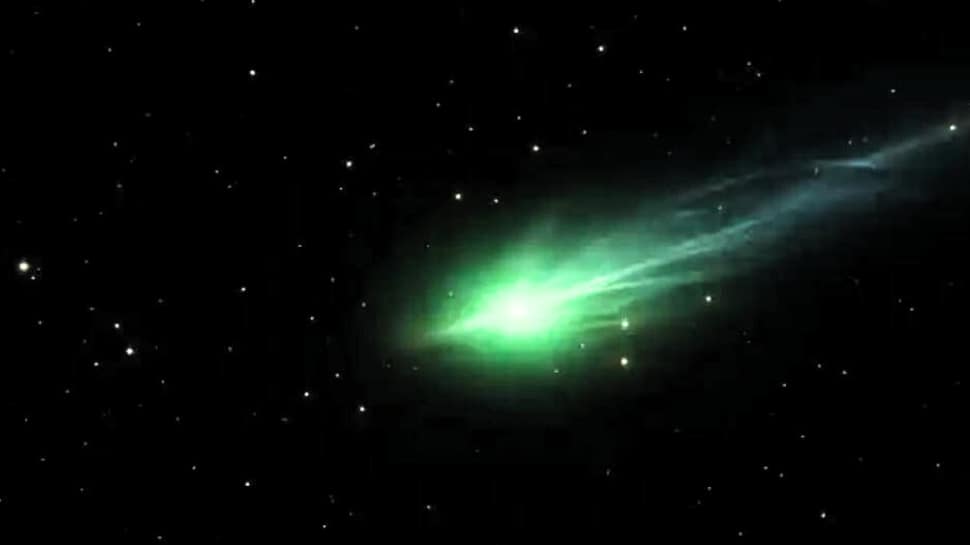

The interstellar comet 3I/ATLAS, a celestial visitor that has defied astronomical expectations since its July 2025 discovery, is once again at the center of intense scientific scrutiny. Initially predicted to break apart under the Sun’s intense gravitational forces, this comet, glowing with an eerie blue-green hue and boasting a tail exceeding a million kilometers, has proven remarkably resilient. Its most recent defiance came after a close passage behind the Sun in November, an event commonly fatal for comets.
Against all odds, 3I/ATLAS emerged from behind the Sun looking remarkably intact, a phenomenon that has reignited a debate about its true nature, attracting widespread internet attention. Leading the charge in questioning its natural origin is Harvard astrophysicist Avi Loeb, a prominent voice in the search for extraterrestrial intelligence.
New photographic evidence from the Nordic Optical Telescope, taken on November 11, supports Loeb’s assertion that the comet remains a single, unbroken entity. Loeb points to the exceptionally powerful mass-loss jets observed around 3I/ATLAS, arguing that their intensity is inconsistent with a natural comet of its estimated size. He calculates that a natural nucleus would require an absorptive surface area larger than Manhattan to produce such outflows, a scale he considers physically impossible based on current data.
In a detailed analysis, Loeb highlights a significant energy puzzle. The solar energy impinging on the comet at its closest approach to the Sun is, according to his calculations, insufficient to fuel the observed jets unless the comet possesses an absorbing area exceeding 1,600 square kilometers. This mathematical inconsistency leads Loeb to propose that 3I/ATLAS might not be a natural comet but potentially an artificial object.
Loeb also draws attention to unusual structural characteristics, such as an anti-tail, a rare feature that inexplicably points towards the Sun. He speculates that the visible jets could be ‘technological thrusters,’ a form of propulsion designed to accelerate the object away from the Sun, potentially explaining its survival and unusual trajectory.
However, this extraterrestrial hypothesis is not universally accepted. Darryl Seligman, an astronomy professor, asserts that 3I/ATLAS’s survival is perfectly explainable by its estimated 1 km nucleus, which is considered large for a comet. He suggests that Loeb’s assumptions about mass-loss rates are likely exaggerated and that the comet is behaving as a robust natural object would.
Further evidence for a natural origin comes from radio observations. South Africa’s MeerKAT telescope detected radio absorption lines from hydroxyl radicals on October 24. This detection, a signature of water molecules being broken apart by sunlight—a hallmark of cometary activity—strengthens the argument that 3I/ATLAS is a water-rich comet undergoing normal sublimation.
The ongoing debate surrounding 3I/ATLAS underscores its importance as a celestial puzzle. Whether a natural marvel or a product of advanced technology, this interstellar visitor is forcing scientists to broaden their perspectives on the objects populating our solar system and beyond.