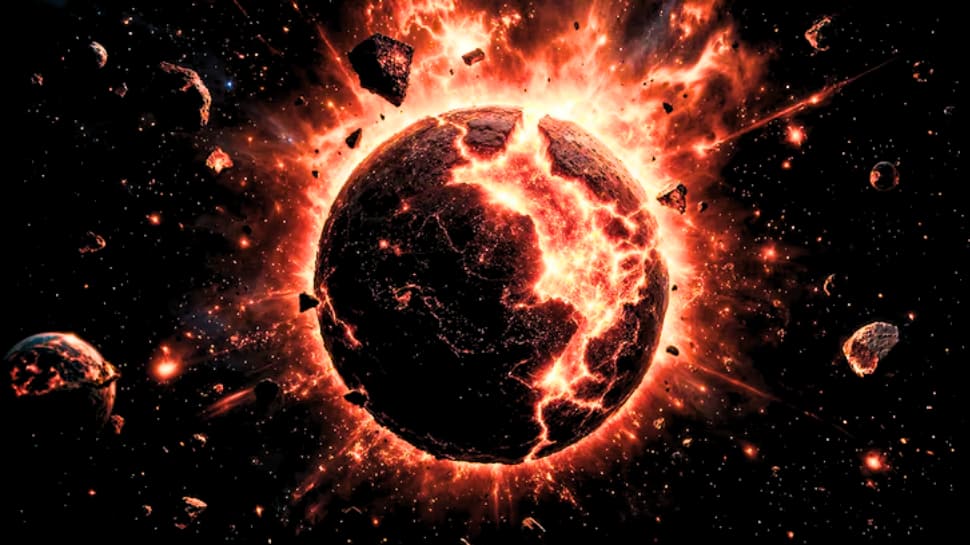

What if the universe isn’t destined for an eternal, frigid expanse? A radical new theory emerging from Cornell University suggests that our cosmos might be headed for a fiery demise rather than a slow freeze. Physicist S.-H. Henry Tye and his colleagues have developed a model proposing that the universe’s expansion will not only stop but reverse, leading to a colossal ‘Big Crunch’ approximately 20 billion years from now.
This startling prediction arises from a re-examination of dark energy, the enigmatic force fueling the universe’s accelerated expansion. Contrary to the long-standing assumption of a constant, positive dark energy, recent observations from powerful telescopes like the Dark Energy Survey (DES) and the Dark Energy Spectroscopic Instrument (DESI) offer compelling evidence for a negative cosmological constant (Λ). If true, this negative value implies that dark energy could eventually turn from an outward push to an inward pull.
Under this new model, the cosmic expansion will halt within the next 10 billion years. This pause will be followed by an accelerated period of contraction, drawing galaxies and matter ever closer. The culmination of this process is predicted to be a Big Crunch, an event where the entire universe collapses into an infinitely dense point, annihilating space, time, and matter.
The theoretical underpinnings of this collapse scenario involve hypothetical particles called ultralight axions. This framework suggests that these axions, which may be related to both dark matter and dark energy, evolve over cosmic epochs. Their gradual evolution could trigger a fundamental change in dark energy’s behavior, shifting its influence from expansion to contraction. This stands in stark contrast to the ‘Big Freeze’ scenario, where the universe simply grows colder and emptier indefinitely.
Despite the theoretical nature of axions and the ongoing mystery of dark energy, the model’s impressive concordance with current data from DES and DESI is significant. These advanced surveys, which map the distribution and movement of millions of galaxies, provide the empirical backbone for this potentially universe-ending theory. Future observatories, including NASA’s SPHEREx, ESA’s Euclid, and the Vera C. Rubin Observatory, will play a critical role in gathering more precise data. Their findings will be instrumental in determining whether our universe is indeed racing towards a final, explosive collapse or if this model represents a misunderstanding of cosmic forces. The question of ‘when and how’ the universe ends is now on the scientific table with calculable timescales.