

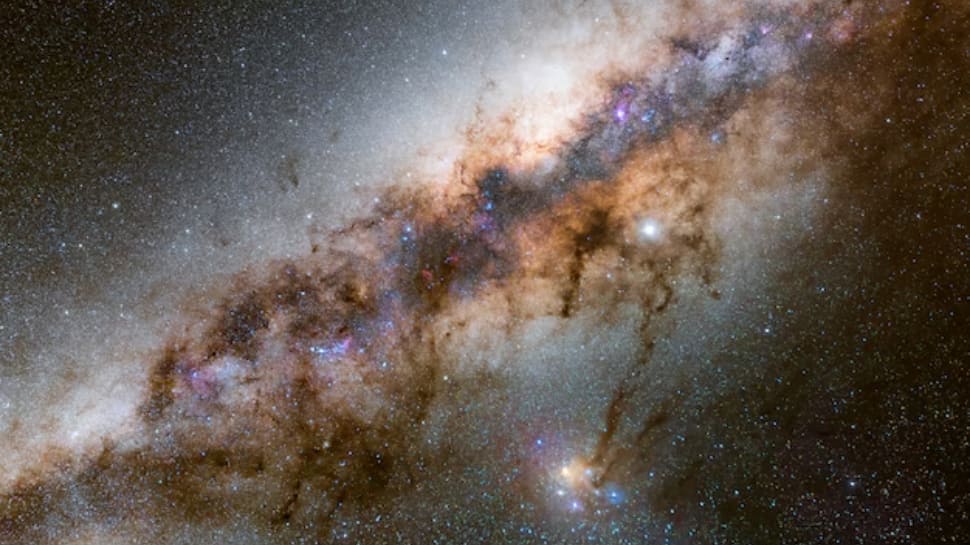

A faint, mysterious glow emanating from the very heart of the Milky Way galaxy could be the first observable sign of dark matter, the invisible substance that dominates the universe. For decades, scientists have theorized about dark matter’s role in binding galaxies and driving cosmic expansion, but direct evidence has remained elusive. A recent study, leveraging data from NASA’s Fermi Gamma-ray Space Telescope, has identified an anomalous gamma-ray signal from the galactic center that doesn’t match known astronomical phenomena. This puzzling emission has led researchers to consider two compelling explanations: it is either generated by the remnants of evolved stars or it is the result of dark matter particles colliding. The confirmation of the latter would be a monumental discovery, providing the first direct proof of dark matter’s existence and fundamentally reshaping our cosmological models. Dark matter is estimated to constitute approximately 85% of the universe’s matter content, yet its non-interaction with light makes it invisible. Scientists have previously relied on indirect gravitational evidence to understand its presence. However, the new findings, bolstered by sophisticated supercomputer simulations of dark matter distribution within the Milky Way, show a strong correlation with the observed gamma-ray data. This suggests that as the galaxy formed and evolved, dark matter may have accumulated in its core, increasing the likelihood of particle interactions that release gamma rays. While the possibility of pulsars being the source remains, future observatories are expected to provide the definitive data needed to confirm or refute this profound discovery.