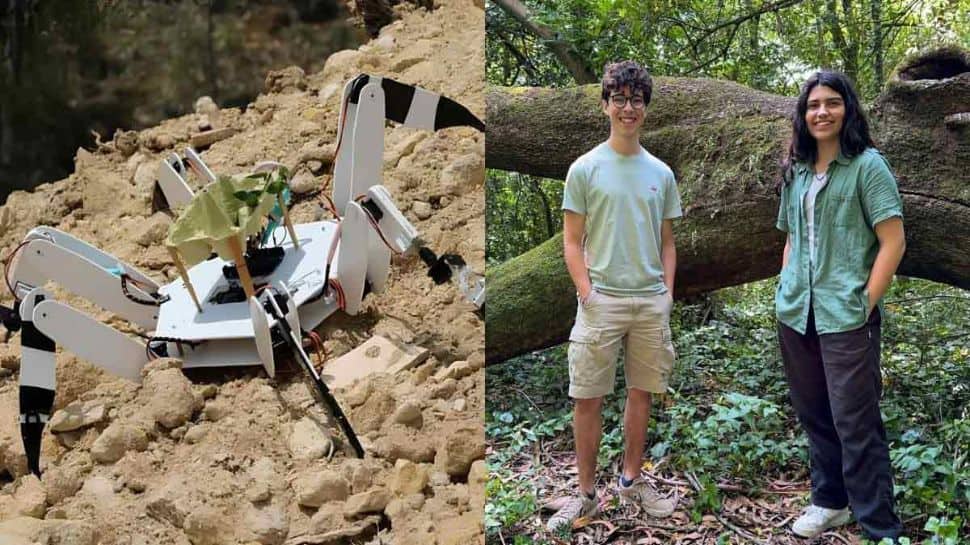

Marta Bernardino and Sebastião Mendonça, once school students in Portugal, were deeply affected by the annual wildfires that ravaged the hills near their homes. These recurring natural disasters became their motivation to create a groundbreaking solution for forest regeneration. Now, at 19, they have developed Trovador, a sophisticated six-legged robot capable of replanting trees in areas too dangerous or inaccessible for human intervention.
Designed to move like a spider, Trovador can navigate difficult, burned terrain, carrying saplings to areas scarred by fire. This invention is poised to make a significant impact in Portugal, a nation that has long battled extensive wildfire damage.
Statistical data underscores the severity of the issue, with over 1.2 million acres of Portuguese forests lost to fires between 1980 and 2023. The year 2017 stands out as a period of immense loss, where wildfires were the primary cause of destruction. The challenging geography, featuring numerous steep slopes, severely limits the effectiveness of traditional manual planting and the deployment of heavy machinery, hindering crucial reforestation efforts.
Bernardino and Mendonça identified this terrain challenge as a critical bottleneck. Their research indicated that more than 60 percent of Portugal’s forests are located on steep inclines, making conventional replanting methods inefficient and slow to address the constant cycle of destruction and degradation.
The Trovador robot emerged from this necessity. Their initial prototype, constructed in 2023 with a shoestring budget and salvaged parts, demonstrated remarkable results. It achieved planting speeds 28 percent faster than human crews and ensured a 90 percent survival rate for the saplings, without requiring further care. This success motivated them to build a more robust model capable of handling slopes up to a 45-degree angle.
“We build all-terrain robots that carry baby trees on their backs and plant them autonomously across difficult terrain,” explained Bernardino. Trovador’s unique six-legged structure distributes weight evenly, preventing soil compaction that can harm young roots. Its advanced systems, including a depth-sensing camera and AI, enable it to identify and avoid obstacles while assessing soil quality, such as pH and moisture levels, before planting. This precision planting method is projected to yield an 85-90 percent survival rate.
In stark contrast to drone-based seeding, which often suffers from low accuracy and germination rates, Trovador’s method of planting individual, rooted saplings in carefully selected micro-sites significantly enhances survival. The robot can plant up to 200 saplings per hour and transmits valuable data to cloud-based systems for monitoring and analysis.
The project has garnered considerable international acclaim, including a $10,000 grant from National Geographic and a prestigious European sustainability award. While environmental experts recognize the robot’s significant potential, they also stress the importance of further evaluation regarding its long-term performance, durability in varied conditions, and navigation capabilities. To maximize accessibility, the creators plan to offer Trovador as a service. Their ambitious timeline aims to have Trovador deployed for large-scale landscape restoration by 2026, addressing the urgent global need for effective reforestation.