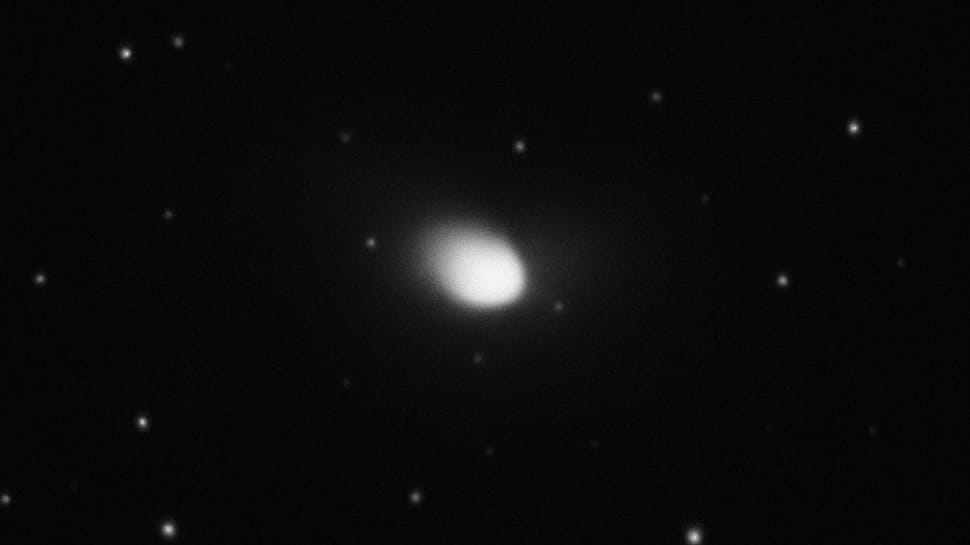

A rare glimpse into the cosmos has been provided by China’s Tianwen 1 orbiter, which successfully captured detailed images of the interstellar comet 3I/ATLAS as it passed near Mars earlier this October. The China National Space Administration (CNSA) released these remarkable photographs, taken between October 1st and 4th, showcasing an object that originated far beyond the confines of our solar system. This celestial encounter offers a unique scientific opportunity.
Interstellar objects are extremely rare, presenting scientists with limited chances to study their composition and behavior. 3I/ATLAS joins the exclusive club of confirmed interstellar visitors, which previously included ‘Oumuamua and 2I/Borisov. The comet’s trajectory near Mars spurred a global scientific response, with agencies like NASA and ESA also focusing their instruments on the object. Tianwen 1, utilizing its High-Resolution Imaging Camera (HiRIC), demonstrated its versatility by diverting from Mars observations to capture the distant comet.
The task of tracking and imaging 3I/ATLAS was technically demanding. The comet, a relatively small body approximately 5.6 kilometers wide, was traveling at speeds close to 129,800 miles per hour (58 km/s). Achieving clear images required the Tianwen 1 imaging team to precisely adjust tracking parameters and extend the orbiter’s observational range. The processed images confirm the presence of a solid nucleus and a diffuse coma, a luminous envelope of gas and dust that can span thousands of kilometers. This success is a testament to the orbiter’s advanced imaging capabilities.
According to the CNSA, this imaging mission served as a significant technical experiment, broadening the scope of Tianwen 1’s operational capabilities to include interstellar object detection. The experience gained will directly benefit future missions, such as Tianwen 2, which is set to embark on an asteroid sample-return mission in May 2025. Tianwen 1, launched in 2020, has a notable history, including its groundbreaking arrival in Mars orbit in February 2021 and the successful operation of the Zhurong rover on the Martian surface. The orbiter continues to be a valuable asset, contributing vital data and furthering China’s contributions to space exploration.