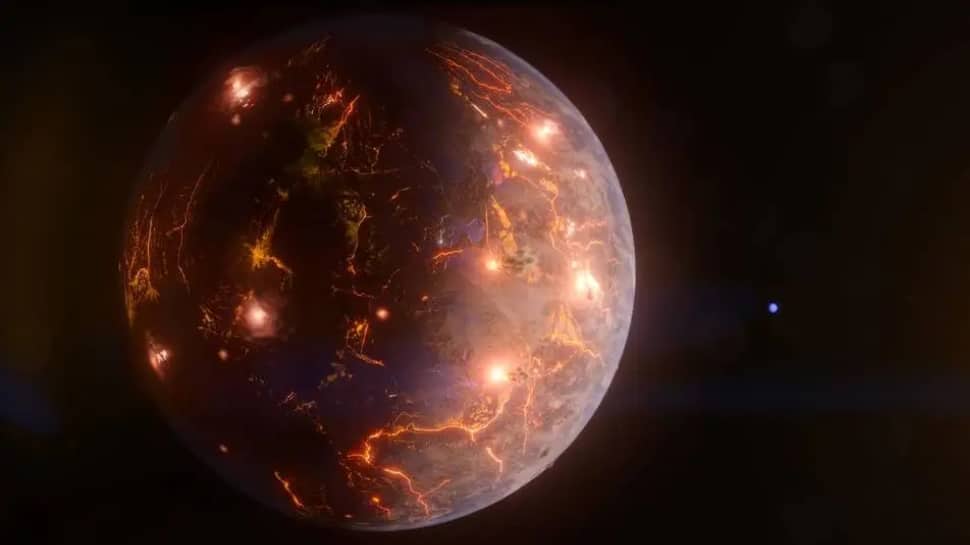

Scientists using the powerful James Webb Space Telescope have identified what appears to be the strongest evidence yet for an atmosphere on a rocky exoplanet. The target of this investigation is TOI-561 b, a super-Earth orbiting incredibly close to its star, located about 275 light-years away.
This ultra-hot planet, roughly 1.4 times the radius of Earth, belongs to the rare class of ultra-short-period (USP) exoplanets, completing its orbit in less than 11 hours. Its extreme proximity to its Sun-like star means it is tidally locked, with one side facing perpetual, searing daylight.
Data captured by Webb’s Near-Infrared Spectrometer (NIRSpec) suggests that TOI-561 b is not a barren rock but rather a world covered in a magma ocean with a substantial overlying atmosphere. This discovery challenges the long-held belief that such intensely irradiated rocky planets would be unable to hold onto any gaseous envelope.
Observations revealed that TOI-561 b has a surprisingly low density for its size. This has led to speculation about its internal structure or, increasingly, the presence of an atmosphere that inflates its apparent volume. The planet is thought to be rich in volatile elements, earning it the descriptive nickname ‘wet lava ball.’
To verify the existence of an atmosphere, the research team meticulously tracked the planet’s heat over nearly four orbits, a duration exceeding 37 hours. They measured subtle temperature variations. Without an atmosphere to distribute heat, the planet’s dayside would reach extreme temperatures around 2,700°C. However, Webb detected a significantly lower dayside temperature of approximately 1,800°C.
This thermal difference strongly indicates that an atmospheric layer is functioning to transfer heat from the intensely hot dayside to the cooler nightside. Researchers propose that TOI-561 b’s atmosphere is sustained by a continuous release and reabsorption cycle with its molten surface. This ongoing process may allow the planet to retain its atmosphere despite the harsh stellar environment. These initial findings from Webb’s Cycle 2 observation program are poised to significantly impact our understanding of planetary formation and atmospheric dynamics on rocky worlds beyond our solar system.