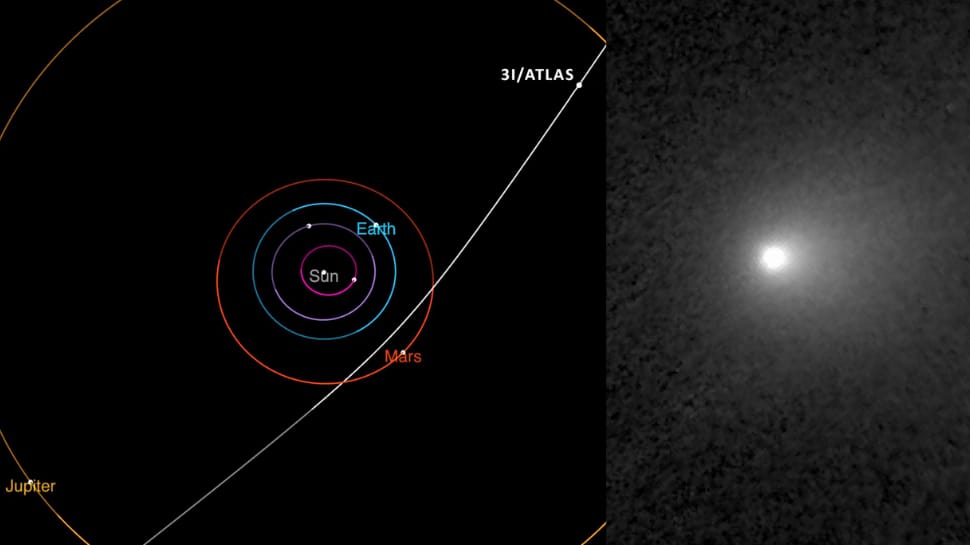

The recent arrival of interstellar comet 3I/ATLAS, confirmed on July 1, 2025, has not only marked the third known object from beyond our solar system but has also ignited intense scientific scrutiny. While its trajectory poses no threat to Earth, the comet’s highly unusual properties have prompted some experts, including Harvard astrophysicist Avi Loeb, to consider the possibility of it being an artifact of alien intelligence.
A key point of debate is the comet’s peculiar chemical signature. It’s emitting a significant quantity of nickel, around four grams per second, but lacks any detectable iron. This absence of iron, despite the presence of nickel, is anomalous and suggests a potential for artificial manipulation of its composition.
Further complicating the natural explanation is the detection of nickel tetracarbonyl, a compound widely used in Earth’s industrial metal refining. Loeb interprets this as a strong indicator that the comet may contain manufactured materials, leaning towards an alien technology hypothesis.
The comet also exhibited an anti-tail – a stream of dust pointing towards the Sun, which is exceptionally rare for cometary behavior. The subsequent change in the tail’s direction, now pointing away from the Sun, has been interpreted by Loeb as potential evidence of controlled movement or deliberate maneuvering, possibly by an intelligent source.
3I/ATLAS’s trajectory is another perplexing feature. It follows a hyperbolic path, indicating it’s not gravitationally bound to the Sun. This characteristic speed and unbound trajectory are consistent with objects that may have been engineered for interstellar transit rather than originating naturally from a star system.
Observations also suggest that 3I/ATLAS has a smooth surface devoid of rocky material, which is atypical for a celestial body of its scale. This smooth, reflective quality could imply construction from refined metals, mirroring the appearance of artificial spacecraft.
With an estimated width of 12 miles and traveling at speeds exceeding 130,000 mph, 3I/ATLAS is exceptionally large and fast compared to other interstellar visitors. These attributes raise profound questions about its propulsion and purpose for interstellar journeys.
Loeb emphasizes that the comet’s overall composition, emissions, and observed behaviors strongly resemble materials used in advanced terrestrial metal processing. He believes this similarity cannot be coincidental and suggests the compelling possibility of an engineered construct of extraterrestrial origin.
As 3I/ATLAS makes its closest passage to the Sun around October 29-30, dedicated observational campaigns by various space agencies are underway. These missions aim to gather critical data that could shed light on the comet’s true nature and its place in the vastness of the universe.